
For most American homes, an 8-foot pool table is the right answer. A 9-foot table is the tournament size and the right answer if you have the room for it and the player to use it, but the 8-foot table is the more livable choice in the vast majority of residential spaces. This piece walks through the dimensions, the room requirements, and the play characteristics that explain why.
The decision is usually framed as "which size is bigger" when it should be framed as "which size suits this room and these players." Bigger is bigger, not better, and the right table is the one that gets used.
Playfield Dimensions and Footprint
The names are slightly misleading. An "8-foot" pool table is named for the playfield length, not the cabinet length. A standard 8-foot table has a playfield of 88 by 44 inches, which is the inner dimension between the cushions. The cabinet itself, including the rails, is closer to 100 inches by 56 inches.
A 9-foot table has a playfield of 100 by 50 inches, with a cabinet closer to 112 by 62 inches. The 9-foot footprint is roughly 12 inches longer and 6 inches wider than the 8-foot footprint, which sounds modest until you walk the cue clearance.
| Size | Playfield (in) | Cabinet (in) | Min Room (ft) |
|---|---|---|---|
| 8 ft | 88 x 44 | 100 x 56 | 13'6" x 17'0" |
| 9 ft | 100 x 50 | 112 x 62 | 14'0" x 18'0" |
The room minimums in the right column assume a standard 58-inch cue. Shorter cues compress the room minimums; longer cues expand them.
Room Requirements Are Where the Decision Gets Real
A 9-foot table needs roughly 14 by 18 feet of clear room, with cue clearance on every side. An 8-foot table needs roughly 13 feet 6 inches by 17 feet, which is meaningfully smaller. In rooms close to the minimum, the 8-foot table almost always lives more comfortably.
The reason is the cue arc. A 58-inch cue plus a back-stroke needs about five feet of clear path on every side of the playfield, which is the dimension that breaks rooms with corners, columns, doorways, or built-ins. A room that fits a 9-foot table on paper often does not fit it in practice, particularly if a wall has a return that intrudes on the play area.
The reliable test is to lay out the playfield in painter's tape and walk the cue path on every side. If the back-stroke clips a piece of furniture or a corner of a wall, the room is short. Detailed dimensions per cue length are at the room size guide.
How the Sizes Play Differently
A 9-foot table is the tournament size. The cue paths are longer, the angles are tighter, and the geometry rewards precise position play. A serious player who has logged hours on a 9-foot table will feel the difference immediately on an 8-foot table, where the same shots happen at a smaller scale.
An 8-foot table plays slightly faster and more forgivingly. The angles are more compressed, which is more accessible for casual players and more entertaining for mixed-skill households. Most home buyers find that an 8-foot table delivers a more enjoyable game more often, particularly in households where the table is shared across players of varying ability.
The 9-foot table is not "more pool." It is a longer table that exposes precise position errors. If the household includes a serious player who specifically wants that exposure (a player who plays in leagues or who has been playing on 9-foot tables in commercial halls), the 9-foot table is the right call. Otherwise, the 8-foot table is the more livable size.
Pocket Geometry and Cushion Behavior
Both sizes use the same K-66 cushion profile and the same residential pocket geometry on a C.L. Bailey table. The corners are cut at a residential standard that rewards good play without punishing mixed-skill households, and the cushions deliver consistent rebound through a wide range of cue speeds.
What changes between the two sizes is the relationship between the playfield and the pocket openings. A 9-foot table has more felt between the player and any given pocket, which means the cue ball has more room to drift off line and the player has more time to read it. An 8-foot table compresses those distances, which means smaller errors close earlier and the player gets faster feedback.
For a serious player practicing position, the 9-foot scale is preferable. For a casual or mixed-skill household, the 8-foot scale produces a more entertaining sequence of shots without changing the underlying mechanics.

View the product
The Skylar
Clean Lines. Convertible Top. Modern in Every Detail.
Cost and Installation
A 9-foot table is more expensive than an 8-foot table at the same model level. The cabinet is larger, the slate is heavier, the cloth covers more area, and the installation crew handles more weight. On a C.L. Bailey table, both sizes are built to the same standards (1-inch industry-standard slate, solid hardwood cabinet, mortise-and-tenon joinery), so the price difference is materials and labor scaling with size, not a quality difference.
Installation also scales. A 9-foot slate bed is heavier and harder to set than an 8-foot slate bed, and the cloth stretch covers more square footage. Both are half-day installations with a trained crew, but the 9-foot table is meaningfully heavier on delivery day, which matters in homes with stairs or tight thresholds.
Pricing comes from your authorized dealer. The locator at /dealer pulls up dealers in your area with current pricing on both sizes for any C.L. Bailey model.
A Short Decision Framework
If you are weighing the two sizes, the questions in roughly this order are usually decisive:
- Does the room genuinely fit a 9-foot table with cue clearance on every side? Walk the painter-tape outline and confirm. If yes, continue. If no, the 8-foot is your size.
- Is there a serious player in the household who has logged hours on a 9-foot table and wants one at home? If yes, the 9-foot is worth the room. If no, the 8-foot is the more enjoyable size for casual play.
- Is the table a single-purpose billiards piece or part of a multi-use room? In a multi-use room, the 8-foot footprint is meaningfully easier to compose with seating, a wet bar, or a TV wall.
- Do you anticipate hosting a household where players of varying ability use the table? An 8-foot table is more forgiving across skill levels.
In our experience, most American homes that fit either size are happier with the 8-foot table. The 9-foot table is the right call for serious players, dedicated billiards rooms, and households where the room has been planned around a 9-foot footprint from the beginning.
A 7-Foot Table Is a Real Third Option
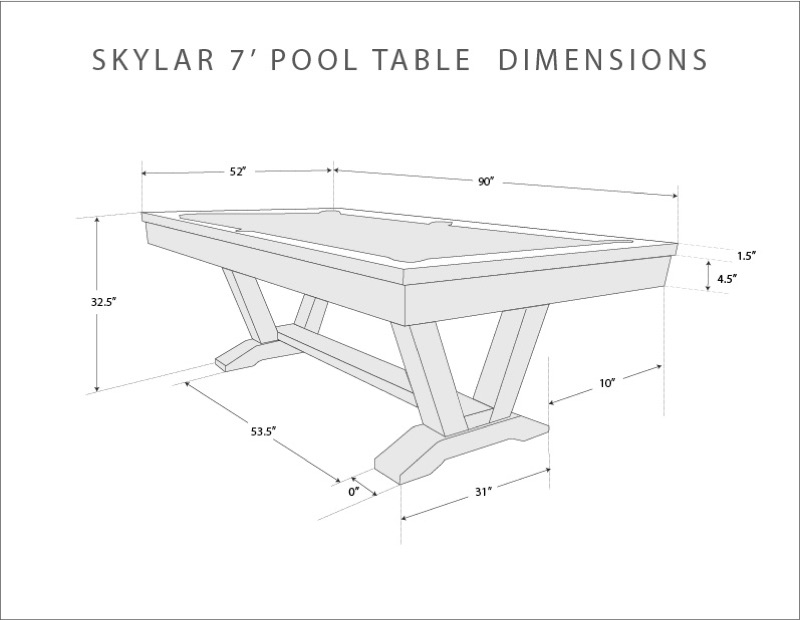
Most of this piece compares the two most-considered sizes, but a 7-foot table is the right answer for some rooms and some households. A 7-foot table fits in roughly 13 by 16 feet, plays in smaller spaces, and is the shared family table for households where the table will see frequent casual use across all ages.
A 7-foot table is also lighter and easier on a floor system. In a converted bonus room, a basement with limited stair access, or a room that has to share space with a TV wall and a sofa, the 7-foot is often the right call.
The model lineup at /products/pool-tables shows which models are available in 7-foot, 8-foot, and 9-foot configurations. Most C.L. Bailey models are available in 7 and 8 foot, with select tournament-capable models also offered in 9 foot.
Where to Go from Here
The room sizing question, with detailed minimums per cue length, is at the room size guide. The full set of considerations for choosing a table is in the pool table buying guide. The model lineup is at /products/pool-tables, and the dealer locator at /dealer connects you to the nearest authorized dealer for size-specific quoting and room-fit advice.
If your room genuinely fits a 9-foot table and you have the player to use it, build the room around the 9-foot footprint. If not, an 8-foot table will make you happier most days of the week.