
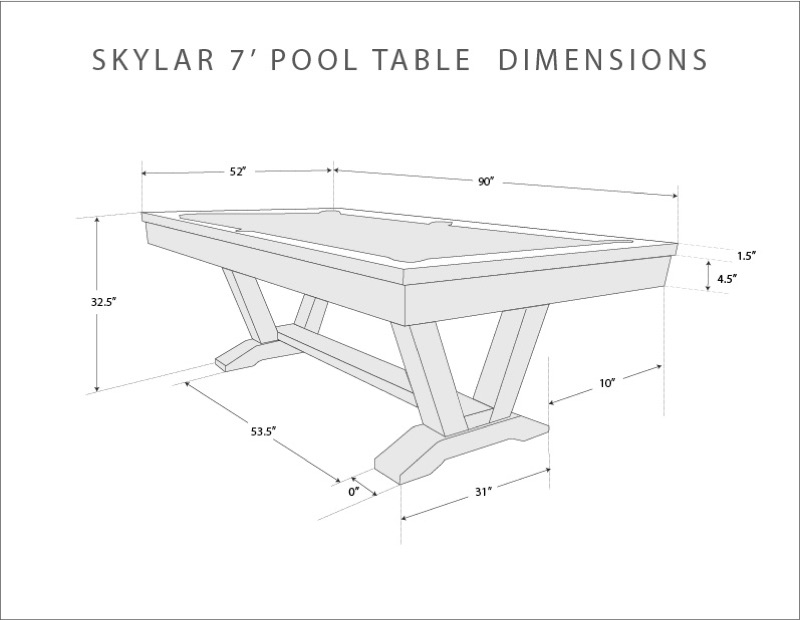
The minimum room size for a pool table depends on two numbers: the playfield dimensions of the table you are choosing and the length of the cue you plan to use. With a standard 58-inch cue, a 7-foot table wants roughly 13 by 16 feet, an 8-foot table wants 13 feet 6 inches by 17 feet, and a 9-foot table wants 14 by 18 feet. This piece walks through how those minimums are calculated and how shorter cues compress the math.
The room dimensions that actually matter are the clear footprint after furniture, columns, doorways, and built-ins are accounted for. A room that scans large on a floor plan can still be too small if a single corner intrudes on the cue arc.
How Cue Clearance Drives the Math
The dimension that breaks rooms is cue clearance. To take a comfortable shot from any side of the table, the cue and the player's back-stroke need a clear path of roughly five feet from the cushion. That is the rough rule for a 58-inch cue, and it is the number that determines minimum room size.
The math is straightforward. Take the playfield length and add ten feet (five for each end). Take the playfield width and add ten feet (five for each side). The resulting rectangle is the minimum room dimension with full cue clearance on every side.
For an 8-foot table with an 88 by 44 inch playfield, the math is 88 + 120 by 44 + 120, which converts to roughly 17 feet 4 inches by 13 feet 8 inches. Round up to 17 by 14 for a comfortable working minimum, or accept the slightly tighter 17 by 13'6" if the room is fixed.
The Standard Minimums by Table Size
The following minimums assume a 58-inch cue and a clear perimeter on every side.
| Table Size | Playfield (in) | Min Room (ft) | Recommended (ft) |
|---|---|---|---|
| 7 ft | 78 x 39 | 13'0" x 16'0" | 14'0" x 17'0" |
| 8 ft | 88 x 44 | 13'6" x 17'0" | 14'6" x 18'0" |
| 9 ft | 100 x 50 | 14'0" x 18'0" | 15'0" x 19'0" |
The "recommended" column adds a foot of breathing room on each side, which is what we suggest if the room can accept it. A room at the absolute minimum plays comfortably but feels tight when more than two people are present. A room at the recommended dimension feels open and accommodates spectator chairs, a wet bar, or a cue rack on a wall without compromising play.
How Shorter Cues Change the Math
A 58-inch cue is the standard, but shorter cues are entirely valid for residential use. A 52-inch cue saves six inches of clearance per side, which compresses the room minimum by roughly a foot in each dimension. A 48-inch cue saves another four inches per side beyond that.
Most C.L. Bailey accessory kits include a mix of cues, and most dealers will swap to shorter cues if the room calls for it. The trade-off is that a shorter cue feels less authoritative on long shots and is harder to control on power breaks. For casual play, the difference is mostly cosmetic. For serious play, a player who has logged hours on a 58-inch cue will feel the shorter cue immediately.
If your room is short by six to twelve inches on one side, a shorter cue is a reasonable accommodation. If it is short by two feet on a side, a smaller table is the right answer instead.
What Actually Goes Inside the Room
The room minimum assumes a clear perimeter, which is rarely how rooms actually look. Doorways, columns, fireplaces, built-in cabinets, low soffits, and the swing of an adjacent door all subtract from the working dimension. The fix is to walk the room with the table footprint marked in painter's tape and physically check the cue path on every side.
The most common intrusions on the cue arc are:
- A doorway on one of the long sides, particularly if the door swings into the room.
- A column or pier that lands within five feet of the table on a corner.
- A fireplace surround that projects into the room from one of the short walls.
- A low soffit (in basements) that catches the cue on a back-stroke from one side.
- Built-in cabinets, bookshelves, or window benches that intrude on the perimeter.
If any of these land in the cue arc, the working room is smaller than the floor plan suggests. The fix is either to move the obstruction, to move the table to a different orientation, or to choose a smaller table.
Orientation: Which Way Should the Table Face
Most rectangular rooms want the table oriented along the long axis of the room. The long sides of the playfield run parallel to the long walls, and the short ends point at the entry and the opposite wall. This orientation maximizes cue clearance on the long sides, which is where most shots are taken.
A table oriented across the short axis of a long room can work if the room is wide enough, but it is generally less comfortable. The long sides become the constrained sides, and the short ends gain clearance that is rarely needed.
In square rooms, the orientation is dictated by the door placement and the supporting furniture. The door should ideally not open onto a long side of the table, and the path from the door to a wet bar or seating area should run along a short end rather than across the play area.

View the product
The Skylar
Clean Lines. Convertible Top. Modern in Every Detail.
Small Rooms and the 7-Foot Option
If your room measures roughly 13 by 16 feet with cue clearance on every side, a 7-foot table is the right size. The 7-foot footprint plays well in tighter rooms, accommodates casual play across a household, and leaves enough breathing room that the room reads as a billiards room rather than as a table jammed into a small space.
A 7-foot table is also the right answer for households where the table will share its room with a TV wall, a sectional, or a wet bar. The 7-foot footprint is meaningfully easier to compose with other furniture without compromising play.
The model lineup at our pool tables page shows which models are available in 7-foot configurations. Most C.L. Bailey families (Skylar, Viking, Dutchess, Tunbridge) are offered in 7 and 8 foot sizes, with select tournament-capable models also available in 9 foot.
A Walk-Through Process
If you are evaluating a specific room for a specific table, the reliable process is:
- Measure the working dimensions of the room, allowing for furniture and built-ins.
- Mark the playfield footprint of the table you are considering in painter's tape on the floor.
- Walk the cue path on every side with a broomstick or cue, simulating a back-stroke.
- If the back-stroke clips a wall, a piece of furniture, or a doorway, note the side and the distance.
- If a single side is short, consider a shorter cue on that side or a smaller table.
- If multiple sides are short, the room calls for a smaller table.
This is the process every authorized dealer will walk you through on a room visit. If you are doing it yourself, the painter-tape method is the most reliable way to confirm the table will fit before installation day.
Where to Go from Here
The broader room planning conversation, including lighting, flooring, traffic flow, and HVAC, is in the room planning pillar. The size choice between 8-foot and 9-foot tables is at the 8-foot vs 9-foot guide.
When you are ready to quote a specific table for a specific room, the dealer locator connects you to the nearest authorized dealer, who can do an in-room measurement if needed. Most dealers will do a room visit before delivery to confirm the working dimensions and any installation considerations.
A pool table is a permanent installation. The room measurement is the part of the planning that, once it is done well, never needs revisiting.


