
A serious pool table is a piece of architecture. It anchors a room for decades, settles into a household, and in most homes outlasts the sofa, the rug, and at least two televisions. Choosing one is not the same as picking a piece of furniture you might replace in five years, which is why the questions that matter are often different from the ones a quick web search will surface.
This guide covers the decisions that actually shape how a table plays, how it ages, and how it fits the room. Sizing, slate, cabinet construction, joinery, finish, cloth, accessories, and how the dealer model affects everything from price to the day the truck arrives. Read the parts that apply, skip the rest, and keep the questions in mind for your authorized dealer conversation.
Start with the Room, Not the Table
The fastest way to end up with the wrong table is to choose the model first and measure the room second. Cue strokes need clearance on every side, and that clearance is non-negotiable. With a standard 58-inch cue, a 7-foot table needs roughly a 13 by 16 foot room. An 8-foot table wants 13 feet 6 inches by 17 feet. A 9-foot table calls for at least 14 by 18.
Those numbers assume a clear perimeter. If a side of the room shoulders a doorway, a column, or a wall of built-ins that lands within the play arc, the working dimension shrinks. We see this most often in basement and bonus rooms where ductwork or a stair stringer steals a foot of clearance no one accounts for on a tape-measure pass.
The right move is to walk the room with a roll of painter's tape, mark the playfield footprint, and check the cue path on each side. If your room is a hair short on one wall, a shorter cue is a real option, but it should be a deliberate choice, not a discovery on installation day. For exact dimensions per cue length, the reference chart at /room-size lays it out by table size.
Pick the Size for the Players, Not the Room Maximum
Once the room can accommodate it, the next decision is which size you actually want to play on. The instinct, particularly when a room can fit a 9-foot table, is to assume bigger is better. It is not. Bigger is bigger, and the right answer depends on who is playing and what the table is for.
An 8-foot table is the most common choice in American homes because it plays well for casual entertaining and serves a serious player without dominating the room. A 7-foot table makes sense in tighter rooms, in bars and rec rooms, and in households where the table doubles as a shared family game. A 9-foot table is the tournament size, with a longer cue path and tighter geometry that rewards (and exposes) skill.
If you are a serious player who has logged hours on a 9-foot table, there is no substitute for one at home. If you are not, an 8-foot table gives most households a more enjoyable game more often. Beginners and mixed-age households tend to drift toward the smaller table over time.
A direct comparison of the two most-considered sizes lives at the 8-foot vs 9-foot pool table guide. Read it before you commit.
Slate Is the Single Most Important Component
A pool table plays well or it does not, and slate is the line. Slate is the stone bed under the cloth that gives the playing surface its flatness and stability. Cheap residential tables substitute MDF, particle board, or a thin slate slab in the inch range, and the difference shows up immediately as drift, dead spots, and balls that arc on long shots.
A serious residential table uses thick slate, typically a full 1" across the entire bed. Thicker slate weighs more, holds its level longer, and resists warping as the room moves through seasons. It also costs more to ship and install, which is part of why thin slate persists in entry-level tables that need to land at a price.
Most residential C.L. Bailey tables are built around 1-inch industry-standard slate set in three matched sections that are seamed together, finished, and leveled at install. The thickness specification is not marketing language. It is the difference between a table that holds its play for thirty years and one that needs releveling every season. The full breakdown is in our slate thickness explainer.
Cabinet Construction: What You Cannot See Matters Most
Cabinet construction is where the marketing language gets thickest, and where it pays to read carefully. The phrases to look for are solid hardwood, mortise-and-tenon joinery, and a clear statement of which species the table uses. The phrases to be careful about are hardwood solids and veneers, engineered wood, wood composite, and wood-look. Those are not synonyms.
A solid hardwood cabinet is built from real lumber throughout. The legs, rails, and apron are made from the same species of wood, joined with traditional joinery, and finished as a piece of furniture rather than as a mass-produced shell. A composite cabinet, even a well-finished one, behaves differently. It expands and contracts on a different cycle from solid wood, the joinery is typically dowels or screws rather than tenons, and once the surface chips you cannot refinish the underlying material.
C.L. Bailey builds every cabinet from solid hardwood throughout, with mortise-and-tenon joinery, in a 65,000 square foot facility in Tomball, Texas. There is no MDF, no particle board, no veneer over composite. That construction choice is what makes the lifetime structural guarantee feasible in the first place. It is also why a C.L. Bailey table lives well beyond the original buyer.

View the product
The Viking
Distressed Hardwood. Industrial Hardware. Built to Command the Room.
Style Should Follow the Room You Already Have
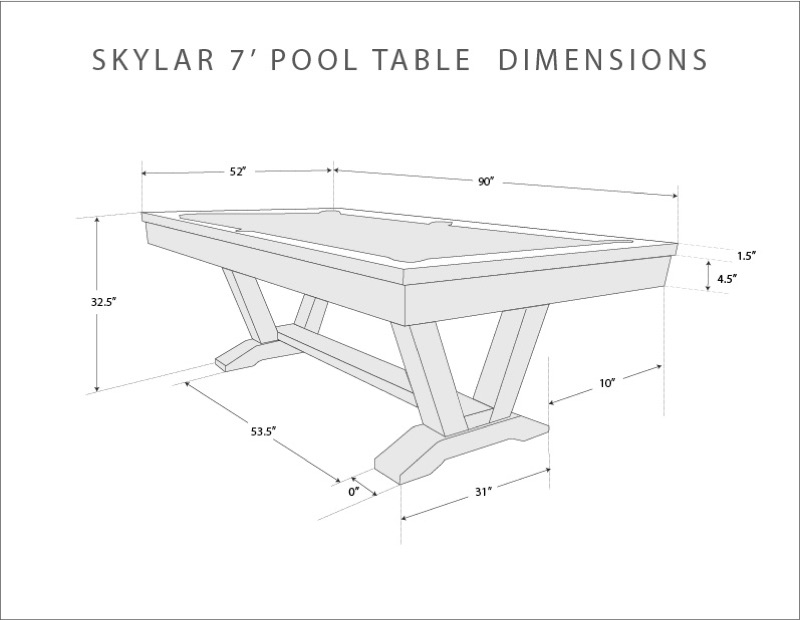
Once the structural choices are settled, style is the easy part. C.L. Bailey offers a range from traditional to contemporary, and the right model is usually the one that disappears into the room you already live in. A Craftsman house with quartersawn oak flooring deserves a Viking. A clean-lined modern home leans Skylar. A formal English-influenced room often finds its match in a Tunbridge or a Dutchess.
The collections page at /collections is the easiest way to see each family in one view, including the matching shuffleboards and game room furniture if you are designing a complete space rather than dropping in a single table. The cabinet, the cue rack, the spectator chairs, and the dining top all belong in the same conversation if you have the room to compose them.
We do not recommend choosing a style based on photographs alone. Hardwood reads differently in a finished room than it does in a studio shot. If you can visit a showroom or arrange a dealer visit, do it. A finish that looks dark on screen often reads warmer and lighter under residential light, and the only reliable way to settle the question is to stand in front of the table.
Cloth: A Choice You Will Make Twice
The first piece of cloth that ships with the table is one decision. The cloth you choose when you replace it in five to ten years is another, and the second decision is often different from the first.
C.L. Bailey tables ship with a choice of two cloth lines, both available through your dealer. Mali is a 21-ounce wool-nylon blend (75 percent wool, 25 percent nylon) with a Teflon coating. It is the classic American billiard cloth, made by the country's oldest billiard cloth manufacturer (founded 1826), and the right choice for most residential installations. The nap gives the ball a gentle slow-down on long rolls, which most casual players prefer.
Velocity Pro is a 21-ounce worsted blend (85 percent wool, 15 percent nylon) with a smooth, nap-free surface. It plays faster and truer than a napped cloth, which serious players prefer because the cue ball goes exactly where it is sent. It is the residential equivalent of the cloth used in tournament rooms.
Most first-time buyers start with Mali because it is forgiving, slows the cue ball down, and reads as a more traditional surface. Many of those same buyers replace it with Velocity Pro the second time because by then they have logged enough hours to want the truer roll. Both are explored, with swatch viewers and color libraries, at /products/cloth.
Accessories Belong in the Initial Conversation
A pool table without cues, balls, a rack, a brush, a cover, and a chalk dish is a blank installation. Most dealers package an accessory kit with the table at purchase, and the kit is worth taking seriously rather than treating as an afterthought.
The right accessory load depends on the household. A family with multiple players wants several cues at different lengths, a wall-mounted rack to keep them off the floor, and a cover that goes on quickly between sessions. A serious player wants two or three quality cues in a closed rack and a Velocity Pro cloth on the bed. A household that hosts often wants a dining top conversion, a set of spectator chairs, and a cue rack the room can read as furniture, not as equipment.
Cue racks deserve a paragraph of their own. A wall rack belongs on a wall the table does not face, where cues are reachable but not sight-line clutter. A floor rack belongs at the head of the table or against a back wall. The rack is part of the room's composition, and most rooms benefit from choosing one in the same finish family as the table.
Lifetime Guarantee Is a Product Decision, Not a Marketing One
A lifetime structural guarantee is a meaningful warranty only if the manufacturer will still be there to honor it. C.L. Bailey has been building tables since 1999 and operates from a domestic facility, which makes the warranty more than a brochure line. Frames, rails, and slate substructure are covered for as long as the original buyer owns the table.
The guarantee covers structural integrity. It does not cover normal wear, which is the right way to draw the line. Cloth, pockets, and rubber bumpers are wear items that get replaced on a longer cycle. Cabinets, frames, joinery, and the slate substructure are the parts that should never need replacement, and they are the parts the guarantee covers.
If you are comparing tables across brands, ask whether the warranty is structural or limited. A limited residential warranty that runs five years is a different document. A lifetime structural guarantee on solid hardwood, backed by a domestic manufacturer with a 25 year history, is a stronger one.
How the Dealer Model Affects Everything
C.L. Bailey sells exclusively through authorized dealers, which is a deliberate choice and one that affects every step of the process. The dealer quotes the table, including any custom finish or hardware options. The dealer manages delivery and installation, which includes seating the slate, leveling, sealing the seams, and stretching the cloth. The dealer is also the first call if anything ever needs attention.
This is different from a direct-to-consumer model where the table arrives in a crate and a contractor handles installation. We use the dealer model because a hardwood pool table is a product that should not be installed by the buyer. Slate seating and cloth stretching are skilled trades, and a poorly installed table plays poorly regardless of what is in the crate.
The locator at /dealer connects you to the nearest authorized dealer with your ZIP code. Pricing is dealer-specific because dealers manage delivery and installation, and a table that requires three flights of stairs is a different installation than one that lands in a ground-floor room.
A hardwood pool table is the kind of object you measure twice and live with for decades. The dealer is the difference between a table that arrives well and one that plays well.
A Short Decision Sequence
If you are early in the process, the order of operations is worth keeping simple. First, measure the room with painter's tape and confirm which sizes will fit with cue clearance. Second, read the room size guide and decide the size you actually want, not the largest one that fits. Third, pick a style by walking the collections and ideally a showroom. Fourth, talk to your dealer about cloth, accessories, and any furniture additions. Fifth, schedule installation around a date that keeps the room clear for a half-day.
There is no rush in any of this. The right table is not a quick decision and the right dealer will not push it. If you are ten minutes into a sales conversation and you are being told you need to commit by the end of the week, you are talking to the wrong dealer.
Where to Go from Here
The cluster of guides under this pillar covers the specific decisions in detail. Sizing lives in the 8 vs 9 foot guide. The slate question is in the slate thickness explainer. Room layout is at the minimum room size piece. Cloth is at /products/cloth, accessories are at /products/accessories, and the model lineup is at /products/pool-tables.
When you are ready to talk to someone, the dealer locator at /dealer pulls up your nearest authorized dealer with quoting and delivery in your area. They will walk you through any of the decisions above in the context of your room, your finishes, and your installation specifics.
A C.L. Bailey table is the kind of purchase you make once. The goal of this guide is to make sure the once is right.