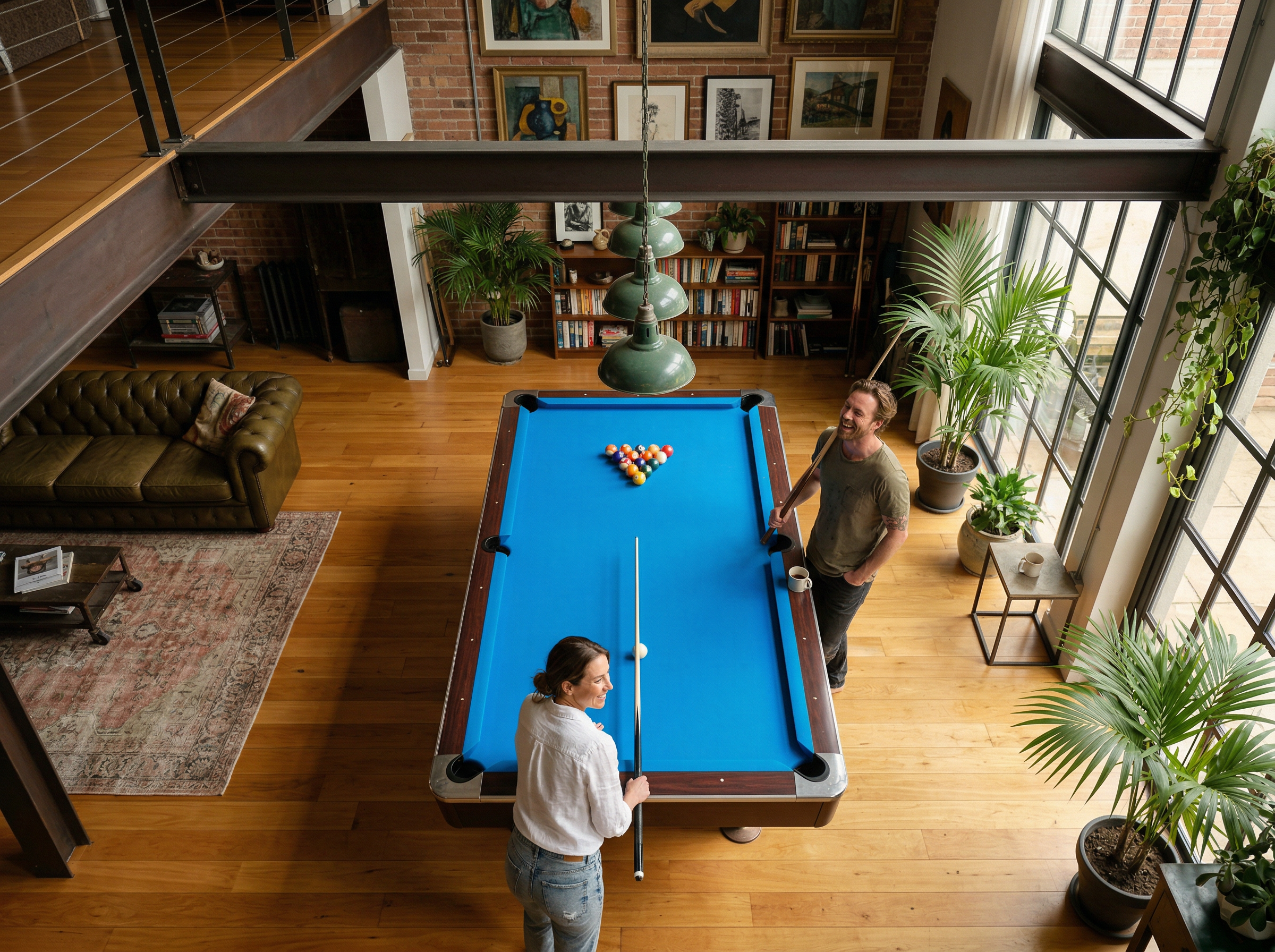

Most pool tables that arrive on a residential floor in the United States are not built. They are assembled. Pieces shipped from several countries land in a warehouse, get screwed together, fitted with a thin slate slab, and crated for a contractor. The cabinet might be hardwood. It might be MDF with a wood-look laminate. The buyer often does not know, and the difference does not show up for a year or two.
A C.L. Bailey table is not assembled. It is built. This piece walks through the actual sequence of how a table is made, from rough lumber to the cloth stretch on installation day, with a focus on the choices that determine how the finished table plays and how it ages.
The Material Decision Comes First
Every cabinet begins with a wood selection. Solid hardwood is the baseline, which means the cabinet, legs, rails, and apron are all built from real lumber rather than a particle core wrapped in veneer. The species choices vary by collection. Viking and Dutchess work in traditional hardwoods sized for a heavier silhouette. Skylar and Tunbridge are built in finer-grained hardwoods that suit cleaner contemporary lines.
This is the first place where the construction decisions cascade. A solid hardwood cabinet allows mortise-and-tenon joinery, accepts a refinishable surface, and can be repaired in place by a competent furniture restorer fifty years from now. A composite cabinet does not allow any of that. Once the surface chips on a composite, the underlying material is exposed, and once the joinery loosens it cannot be tightened with new dowels because the dowel holes themselves are weakening.
Solid hardwood costs more, ships heavier, and requires more skilled labor in finishing. It is also the only material that supports the kind of warranty we offer.
Joinery: Mortise-and-Tenon Throughout
The traditional way to join solid hardwood is a mortise-and-tenon joint. A rectangular tenon is cut on the end of one piece, a matching mortise is cut into the receiving piece, and the joint is glued and clamped. The resulting joint is mechanically interlocked, which means it carries load through wood-on-wood contact rather than through fasteners that can loosen over time.
Mortise-and-tenon is what good furniture has been built with for centuries. It is also slower and harder than the alternatives. Dowel joinery is faster on a production line. Pocket-screw joinery is faster still. Both work well enough for furniture that is expected to live a decade. Neither carries a structural lifetime guarantee.
C.L. Bailey cabinets are joined with mortise-and-tenon throughout. The legs to the apron, the apron to the rails, the rails to the corner posts. Every joint that takes structural load is cut, fitted, and glued in the way a finish carpenter would have done it in 1899, because that is what the wood wants to do and what the warranty requires.
The Slate Bed Is the Heart of the Table
The cabinet is the structure. The slate is the playing surface. A pool table plays well or it does not, and the slate is the first variable.
Slate is a sedimentary rock that splits cleanly along a parallel plane, which makes it a natural choice for a flat playing bed. A dense, fine-grained slate machines flat and stays flat, which is exactly what a playing bed needs. C.L. Bailey tables use 1-inch industry-standard slate, set in three matched sections, on every residential model that supports it.
1" 3 Every BedThe slate arrives at the manufacturer cut and ground flat. Each section is matched to its neighbors so that when seamed, the three pieces form a continuous bed without ridges. The bed is then bolted to a hardwood substructure, which is itself bolted to the cabinet. This is where the load transfers happen: the slate holds the play, the substructure carries the slate, the cabinet carries the substructure, the legs carry the cabinet, and the floor carries the legs.
Thickness matters because the slate has to resist deflection under its own weight and the weight of cue strokes for decades. Thin slate sags microscopically over time, and a millimeter of sag becomes a dead spot on a long roll. A 1-inch bed sits stable for the life of the table. That is the industry standard, and the detailed treatment of why thinner slate fails is at the slate thickness explainer.
Rails, Cushions, and Pocket Geometry
The rails are the wooden frame around the bed, and the cushions are the rubber strips inside the rails that the ball bounces off. Rail design is one of the more underappreciated parts of a pool table because most buyers think about the cabinet and the slate and never think about the rails until the cushions go dead.
The cushions on a C.L. Bailey table are K-66 profile gum rubber, which is the residential standard for predictable rebound. K-66 cushions deliver a consistent angle off the rail through a wide range of cue speeds, which is what most players are calibrating to without thinking about it. Cushions wear over a long period of play and are replaceable through your dealer when they go.
Pocket geometry is the cut and shape of the six pockets. The corner pockets and side pockets are cut to specific angles that determine how forgivingly a ball drops. Tournament tables run tighter pockets than recreational tables, and most C.L. Bailey models split the difference at a residential standard that rewards good play without punishing mixed-skill households. The pockets themselves are leather drop pockets on most models, which read as furniture rather than as plastic baskets.

View the product
The Dutchess
Diamond Inlays. Rich Wood Tones. Heirloom Presence.
Finish Work Is a Furniture Discipline, Not a Production Step
The cabinet leaves rough construction with the joinery cut and the legs attached. From there it moves to finishing, which is the discipline that makes a pool table read as a piece of furniture rather than as a piece of equipment.
Finishing is sanding, staining, sealing, and topcoating. On a C.L. Bailey cabinet, the sanding sequence runs through multiple grits to get an even substrate. The stain is applied by hand, wiped, and inspected for evenness. The topcoat is sprayed in multiple coats with a hand-sanding step between coats to knock down any raised grain. The final coat is rubbed out to the specified sheen, which is typically a satin or a hand-rubbed semigloss depending on the collection.
This is where you can see the difference between a hand-finished cabinet and a production-line cabinet. A production cabinet takes a single sprayed finish, often with the wood under-prepared, and the surface reads as plastic. A hand-finished cabinet takes a finish that absorbs into the wood, reads as wood under direct light, and accepts a touch-up if the surface is ever damaged.
Assembly, Quality Control, and Crating
Once finishing is complete, the cabinet, slate, rails, cushions, and pockets are dry-fitted at the manufacturer to confirm the parts fit together as designed. The slate sections are checked for level on the cabinet substructure. The rail angles are checked for square. The cushion rebound is tested. Any piece that does not pass goes back to the bench.
After QC, the table is broken down into shippable components: cabinet, slate sections, rails, cloth (chosen by the buyer through their dealer), pockets, and accessory hardware. The components are crated for shipping, addressed to the dealer, and held until the buyer is ready for delivery. A C.L. Bailey table does not arrive at the buyer's home in a flat-pack carton from a third-party warehouse. It arrives at the dealer, who delivers it on a scheduled installation day with a trained crew.
This is part of why dealer pricing varies by region. The dealer is not just collecting margin. The dealer manages delivery logistics, installation labor, and post-installation warranty service, all of which scale with how far the table travels and how complex the installation is.
Installation: Where the Table Becomes a Pool Table
Most of what determines how a table plays happens at installation. The cabinet is set in place and leveled to the floor. The slate substructure is bolted to the cabinet, and the slate sections are set on the substructure. The slate is leveled across the entire bed using shims, with a bubble level checked at multiple points and a long straightedge run across all three sections. Once the bed is flat, the seams between the slate sections are filled with beeswax or a similar filler, troweled smooth, and sanded flush.
The cloth is then stretched over the bed. Stretching is a skilled trade because the cloth has to lie flat on the slate without wrinkles or bunching, with consistent tension across the entire surface. A poor stretch shows up immediately as the ball reading the cloth differently in different parts of the table. A good stretch reads as a single uniform surface.
The rails are then mounted to the cabinet, with cloth stretched over each rail individually and trimmed at the cushion line. The pockets are mounted into the rail openings. The accessories (cues, balls, rack, brush, cover) are unboxed and placed.
A full residential installation runs about three to five hours with a two-person crew. The installer will leave the table playable at the end of the day, with the cloth fully stretched and the slate fully leveled. Cloth needs about a week of light play to settle into the rails, but it is ready to use from the first hour.
Cloth Is the Last Variable, and It Will Be Replaced
Cloth is the only major component on a pool table that is meant to be replaced. Cabinets last a lifetime. Slate lasts a lifetime. Rubber cushions last decades. Cloth runs five to ten years in a residential setting before it shows wear that affects play.
C.L. Bailey tables ship with a choice of two cloth lines: Mali wool-nylon blend, the classic American billiard cloth, or Velocity Pro worsted, the high-performance alternative. The choice depends on how seriously you play and how forgiving you want the surface to be. The detailed comparison is at the worsted vs napped explainer, and the swatch viewer is at /products/cloth.
When the cloth eventually needs replacement, the dealer comes back, removes the rails, strips the old cloth, stretches new cloth across the bed and rails, and remounts the rails. It is a half-day job, and most buyers refresh the cloth and the cushions at the same time. The cabinet, the slate, and the substructure underneath go on living.
The Lifetime Guarantee Is What All of This Adds Up To
A lifetime structural guarantee is only as meaningful as the construction it covers. We can offer a lifetime warranty on frames, rails, and slate substructure because the joinery is mortise-and-tenon, the wood is solid hardwood, and the slate is set on a hardwood substructure that does not flex.
Wear items (cloth, cushions, pockets, brushes, covers) are not covered, because they are not supposed to be. They are designed to wear and to be replaced. The cabinet underneath them is designed to outlast the original buyer.
The guarantee covers the table for as long as the original buyer owns it. If something structural ever fails, your dealer is the first call. They will handle the warranty claim and the repair, with parts and labor covered.
A pool table is built well or it is not. The construction decisions are made before the buyer ever sees the cabinet, and they show up in how the table plays at year one and how it plays at year thirty.
Where to Go from Here
If you are reading this because you are evaluating a table, the pool table buying guide is the broader companion piece. It covers sizing, room planning, accessories, and the dealer relationship. The slate question is in the slate thickness explainer. The cloth question is in the worsted vs napped piece.
When you are ready to talk to someone, the dealer locator at /dealer connects you to the nearest authorized C.L. Bailey dealer with quoting and delivery in your area. The collections themselves live at /products/pool-tables, /products/shuffleboards, and /products/game-room-furniture.
The work that goes into a hardwood table is not visible in a photograph. It shows up in the years that follow, which is the right time horizon for a piece that is meant to outlive the original buyer.